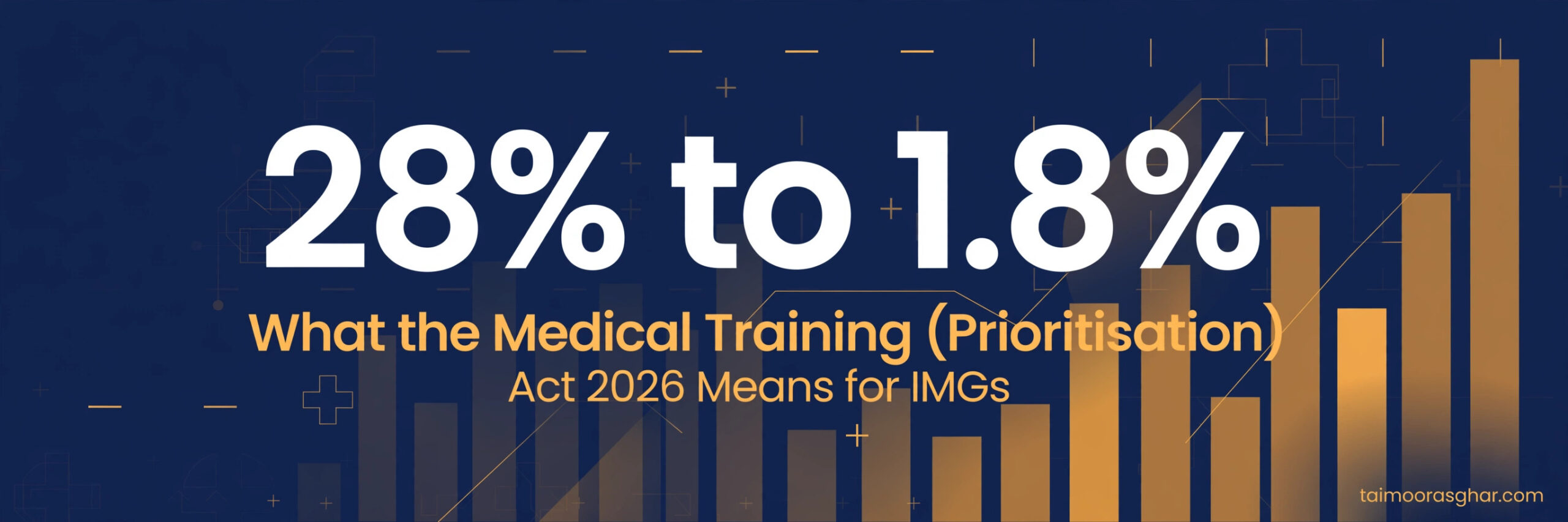
Short answer: The Medical Training (Prioritisation) Act 2026, which received Royal Assent on 5 March 2026, requires UK medical training places to be offered first to UK graduates and defined priority groups. In 2026 it is applied at the offer stage; from 2027 it will apply from shortlisting onwards. Nuffield Trust analysis of NHS data shows specialty training places going to non-priority doctors fell from 28% in 2025 to 1.8% in 2026.
What is the Act, and why was it passed?
The Act began life as the Medical Training (Prioritisation) Bill, introduced to Parliament as emergency legislation in January 2026. It received Royal Assent on 5 March 2026 and sets a statutory requirement that UK medical graduates are prioritised for foundation and specialty training posts.
The reason given for the emergency is the competition crisis in postgraduate training. In the decade to 2025, total specialty training applications in England rose more than fivefold, from about 16,500 to almost 85,000 a year, driven mainly by applications from overseas, according to analysis by the Nuffield Trust. Resident doctors were increasingly facing the prospect of finishing medical school or foundation training with no training post to progress into. The government presented the Act as a way to protect the domestic training pipeline and encourage UK-trained doctors to stay in the NHS.
The policy is controversial precisely because the NHS has for decades depended on international medical graduates. More than half of GP registrars are IMGs, according to the Royal College of General Practitioners, and the Act was introduced while the workforce gap in many specialties was still being filled substantially by doctors trained overseas.
How does prioritisation actually work in practice?
The mechanics differ between the 2026 and 2027 recruitment rounds, and the difference matters.
For training programmes starting in 2026, shortlisting was already under way when the legislation passed. Prioritisation was therefore applied at the offer stage: offers were made to priority applicants first, and only then to other eligible applicants who remained. An IMG could be fully eligible, pass through shortlisting, and still miss out because the posts were exhausted by priority candidates.
From the autumn 2026 application round for 2027 starts, prioritisation applies throughout the process, from shortlisting through to the allocation of offers. That is the key shift most commentary underestimates: from 2027, in competitive specialties, non-priority applicants may never reach interview at all, because the filter now operates earlier in the pipeline.
For the Foundation Programme, the Act requires places to be allocated first to applicants holding a UK primary medical qualification, followed by other priority groups, before being offered to remaining applicants. One practical footnote from the BMA: because of the timing of the law, Foundation Priority Programmes were not run as a separate recruitment process in 2026. Those posts were added to the main round and allocated through Preference Informed Allocation.
Who is in the priority group?
For 2026 specialty training, the priority groups, as set out in government and BMA guidance, are:
- UK medical graduates
- Doctors with a primary medical qualification from a medical school in the UK or the Republic of Ireland
- Doctors with a primary medical qualification from a medical school in Iceland, Liechtenstein, Norway or Switzerland
- Doctors who have completed, or are currently on, a relevant qualifying UK training programme, such as the Foundation Programme
- British citizens, Commonwealth citizens with the right of abode, and Irish citizens who do not require leave to enter or remain
- People with indefinite leave to enter or remain in the UK
Two details from the BMA’s explainer are worth knowing because they surprise many doctors.
First, international students studying at UK medical schools are considered UK graduates for this purpose, regardless of nationality or immigration status. The category is about where you trained, not what passport you hold.
Second, the reverse also holds: UK nationals who studied medicine at an international university were not prioritised for foundation training in 2026, regardless of their nationality. A British passport does not put you in the priority group if your degree came from outside the listed countries.
From 2027, the Act also gives the government powers to prioritise applicants with “significant NHS experience” alongside the existing groups. The definition of “significant” is still being worked out. For the 2027 cycle, the government has confirmed that the interim arrangement rolls over for another year: immigration status continues to be used as a proxy for significant NHS experience while further analysis and impact assessments are completed.
What do the numbers show so far?
The first data on the Act’s impact is stark. Analysis of NHS data by the Nuffield Trust found that the proportion of doctors from the non-priority group accepting a specialty training place fell from 28% in 2025 to 1.8% in 2026, meaning fewer than one in fifty places went to non-priority doctors this year. The think tank’s fellow Lucina Rolewicz said the numbers show how dramatically the rules have shifted access to specialty training away from overseas-trained doctors and towards predominantly UK-trained doctors.
The broader recruitment picture tells the same story. Reporting on the 2026 round found that competition ratios halved, prioritised doctors filled 98% of roles, and every new GP training post was filled by UK graduates and priority groups. Against that, the Royal College of General Practitioners’ reminder that over half of GP registrars are IMGs suggests the longer-term workforce consequences have not yet been worked through.
What are the professional bodies saying?
The Academy of Medical Royal Colleges published its position statement on 29 June 2026. It notes that the NHS has relied on IMGs working alongside UK and Irish trained doctors for many years, and that rising numbers of UK and Irish graduates have produced unsupportable competition ratios across all specialties. The Academy supports the Act’s aim of encouraging homegrown talent to stay, and on the open question of “significant experience” it takes a clear view: the threshold should be no less than two years, to match foundation training, and no more than three years. The stated reasoning is that this allows IMGs to gain cultural competence and an understanding of how the NHS works, while rewarding colleagues already delivering patient care across the country.
The Royal College of Physicians welcomed Royal Assent, with its president Professor Mumtaz Patel saying escalating competition ratios had been a major factor in early career doctors’ growing uncertainty. The College stressed that the vital contributions of IMGs must be recognised and that the focus should now be on defining “significant NHS experience” in time for the 2027 recruitment round. The Royal College of Psychiatrists, in a briefing published in January 2026, recommended the NHS service requirement be set at two years, aligned with the length of foundation training.
Not everyone agrees with the approach. Doctors Association UK called the Bill “unfair and unethical” for changing eligibility criteria when international graduates had entered the workforce under existing rules, after investing thousands of pounds in PLAB examinations, GMC registration, relocation and visa renewals. The Royal College of General Practitioners said it understood the rationale but called for fair solutions, more training roles and more trainers.
The BMA’s response to the Nuffield Trust analysis tried to hold both views at once. Its council chair Dr Tom Dolphin said the Act had clearly had a major effect in reducing the proportion of places going to non-priority groups, and that it was vital to stop UK-trained doctors being lost to the NHS. But he also said the blame lies with NHS workforce planning, both for leaning so heavily on international doctors and for leaving the whole training system short of places, and that prioritisation itself creates no new places.
The government, for its part, pledged to create an additional 1,000 specialty training posts in England, with applications from April 2026.
What changes from 2027?
The honest answer is that the single most important detail is still undecided. “Significant NHS experience” is undefined in the Act, left to future regulations. The Academy’s proposal of two to three years is influential but not yet law. The government is seeking views on what the term should mean, and until regulations land, the immigration-status proxy rolls over for the 2027 cycle.
For an IMG, this means 2027 is the year the Act bites hardest. Shortlisting-stage prioritisation plus an unsettled definition of experience creates real uncertainty for anyone outside the current priority groups. If you are building NHS experience now, the two-to-three-year window suggested by the Academy is the figure most worth watching.
The honest read for IMGs
Cutting through the anxiety, here is how the position looks for different groups.
If you hold or are on track for a UK foundation programme, settled status or citizenship, or a primary qualification from the listed countries, your position is largely protected. International students at UK medical schools are counted as UK graduates. Nothing in the Act targets you.
If you are an IMG without UK training experience or a qualifying immigration status, the structural queue has moved against you. That is not rhetoric; it is the 28% to 1.8% figure. In specialties where priority candidates fill every post, non-priority applicants now sit behind a statutory queue. From 2027, with prioritisation at shortlisting, you may not be seen at all in the most competitive specialties.
A few things that remain true and worth holding on to:
- PLAB, now aligned with the UK Medical Licensing Assessment, remains the GMC registration route. Registration and training access are separate questions.
- Service and trust-grade posts, and the less competitive specialties and locations, remain routes to NHS experience, and the Nuffield Trust has noted that the policy does nothing to make less popular specialties and locations more attractive to UK graduates. Gaps persist where UK graduates are less keen to go.
- The “significant NHS experience” definition, once settled, is the most likely route for experienced IMGs to re-enter the priority group.
The wider question is whether the UK still offers the strongest long-term pathway for a doctor starting from zero today. That calculation is personal, and I will not pretend there is one right answer. I built my own career outside the UK, and the existence of credible alternatives, from Australia to Denmark, is the subject I keep returning to on this site. For now, what matters is that the decision is made with the facts as they are, not as they were three years ago.
Frequently asked questions
Does the Act ban IMGs from UK training?
No. It prioritises, it does not exclude. IMGs can still apply, and from 2027 doctors with “significant NHS experience” may be prioritised alongside UK graduates. But in specialties where priority candidates fill every post, non-priority applicants never reach an offer.
I am a UK citizen who studied medicine abroad. Am I prioritised?
No. The BMA confirms that no international medical graduate (other than graduates of Ireland, Iceland, Liechtenstein, Norway and Switzerland) was prioritised for foundation training, regardless of nationality. The category follows where you trained.
I am an international student at a UK medical school. Am I prioritised?
Yes. International students are considered UK graduates for prioritisation, regardless of nationality or immigration status.
How much NHS experience counts as “significant”?
It is not yet defined. The Academy of Medical Royal Colleges proposes two to three years, and the government is consulting on the definition. For the 2027 cycle, immigration status remains the interim proxy.
Is PLAB still worth doing?
PLAB remains the route to GMC registration, and registration is separate from training access. Whether it is worth it depends on whether UK specialty training, rather than UK registration alone, is the goal.
The bottom line
The Medical Training (Prioritisation) Act 2026 is the most significant change to UK medical career access in a generation. The 2026 numbers, 28% to 1.8%, show it has done what it was designed to do. From 2027, prioritisation at the shortlisting stage makes the queue earlier and stricter, while the definition of “significant NHS experience” remains the open question that will decide how many experienced IMGs can still progress. For IMGs planning a UK career, the right move is to understand exactly which group you fall into, watch the 2027 regulations, and make the decision with current facts, not old assumptions.
This article is general information about UK training policy and does not replace personalised careers or immigration advice. If your plans are affected, speak to a qualified adviser or your royal college.