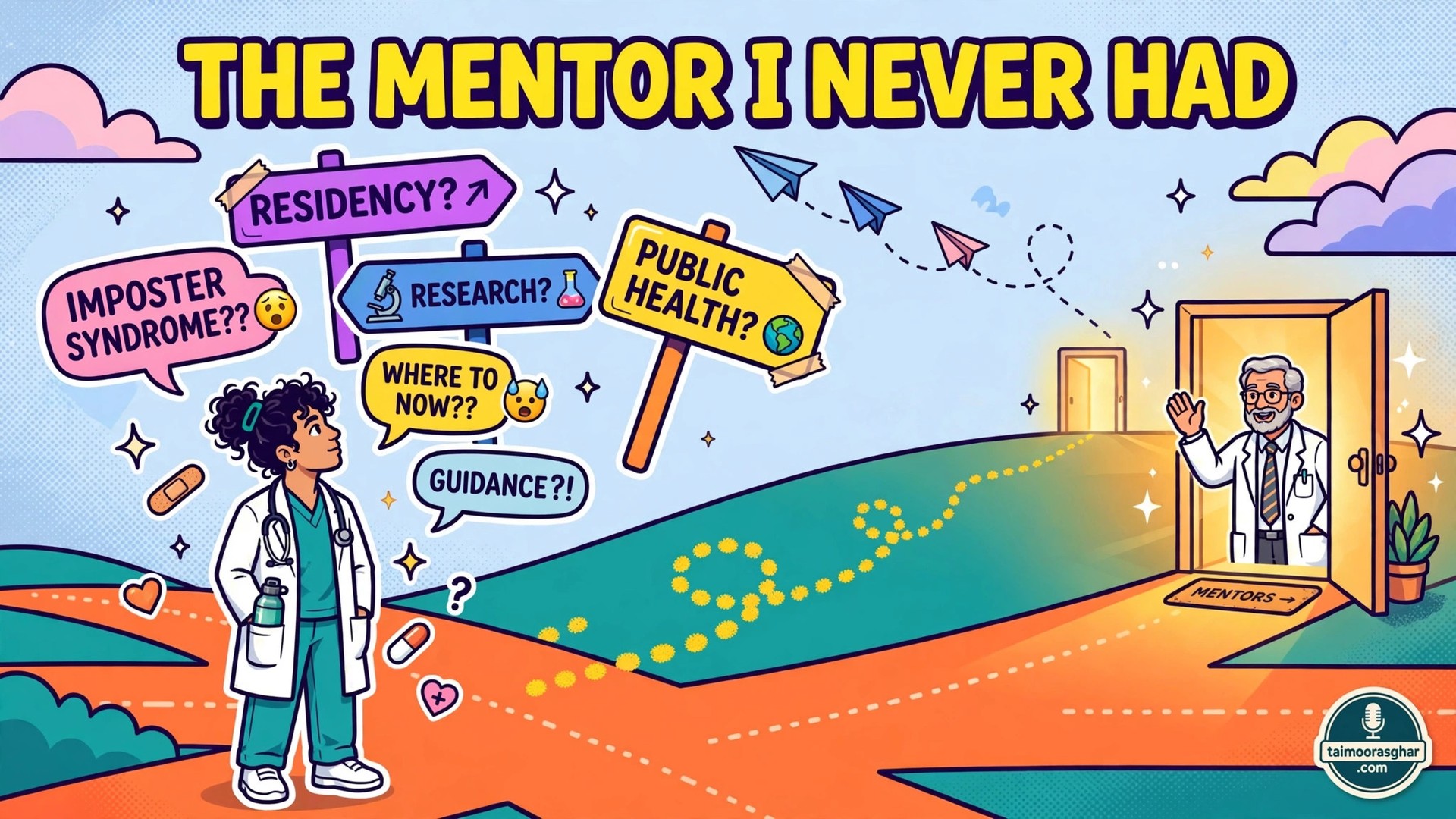
Search for IMG mentorship guidance and you will find plenty of encouragement. What you will not find, in most first posts, is an actual mentor. In a 2024 survey of international medical graduates in the United Kingdom, 86 percent said they had no dedicated mentor in their first NHS job. That single figure explains a great deal about why capable doctors stall after migration, and it is the honest starting point for this article.
The short answer is this: as an international medical graduate, you probably will not be given a mentor. You will have to build one, and usually more than one, from supervisors, peers, societies and communities. The good news is that there is now published evidence on how doctors do this, and the methods are practical rather than mysterious.
This is a reflection on the mentorship gap, and a working guide to closing it for yourself.
How many IMGs start their first job without a mentor?
The clearest recent number comes from Lane, Shrotri and Somani, who surveyed doctors about support during their first NHS appointments and published the results in the Scottish Medical Journal in 2024 (PMID 38374650). The survey gathered responses from 173 international medical graduates and 16 doctors trained in Britain as a comparison group.
In their first NHS job, 86 percent of the IMG respondents had no dedicated mentor. That was not the only gap. Fifty six percent had no dedicated supervisor, 52 percent had no induction, 59 percent had no shadowing period, and 52 percent had no study leave. When the same doctors were asked what would improve the transition, mentors were near the top of the list: 78 percent asked for mentors, 80 percent for teaching sessions, 76 percent for work orientation and 61 percent for a supernumerary period.
Two cautions belong with these numbers. The survey was distributed through closed medical groups, so it reflects the experience of doctors who chose to respond rather than a random sample of every IMG. And the comparison group was small. Even with those limits, the direction is consistent with everything else published on this subject: formal guidance is the exception in a first post, not the rule.
The scale of the workforce makes the gap more significant. The General Medical Council’s workforce reporting puts doctors who qualified outside the UK at around 42 percent of the licensed medical workforce, and the University of Plymouth summary of current GMC figures describes international graduates as just over 40 percent of the nation’s doctors. A system that depends on this group for two fifths of its medical workforce still leaves most of its new arrivals to find their own way in.
Does the mentorship gap affect who becomes a consultant or a GP?
It appears to, although mentorship is one factor among several and the evidence is observational rather than experimental.
The SUP IMG project, a three year study funded by the National Institute for Health and Care Research and led by the University of Plymouth with colleagues at Oxford, University College London and Imperial College London, is examining precisely this question. Building on research carried out for the GMC in 2021, the project reports that fewer than 5 percent of international graduates join the specialist or GP registers on arrival. Only 11.6 percent become consultants or GPs within five years of joining the register, and 27.2 percent within ten years. The same summary puts the figure for UK graduates at around 75 percent over the same timeframe.
The project is investigating a bundle of explanations, including language and cultural differences, difficulties gaining work experience, and direct or indirect discrimination. To that list, the GMC’s own work on differential attainment adds a quieter mechanism. Research summarised for the NHS Race and Health Observatory found that poorer outcomes in postgraduate training were linked to weaker relationships with supervisors and peers, fewer stretch opportunities, less informal feedback, and fewer informal mentorship relationships. In other words, the informal layer of medicine is not decoration. It is part of how opportunities are distributed.
Retention data point in the same direction. The GMC’s State of Medical Education and Practice workforce report for 2025, covered by The BMJ, found that 4,880 doctors who obtained their primary medical qualification outside the UK left UK practice in 2024, a rise of 26 percent on the 3,869 who left in 2023. The report does not say why each doctor left, and it would be wrong to claim mentorship explains the increase. But a workforce that arrives without guidance, progresses more slowly, and then leaves in rising numbers has a guidance problem somewhere in the chain.
The Medical Training (Prioritisation) Act 2026, which I wrote about on this site earlier this week, adds further pressure by formalising priority for UK graduates in training allocation. When the formal route narrows, the informal route, who advises you, who warns you, who puts your name forward, matters more, not less.
What is the difference between a supervisor, a mentor and a sponsor?
These three roles are often blurred, and confusing them wastes time.
A supervisor is accountable for your clinical work. In UK practice this is your clinical or educational supervisor: they observe, assess, sign off and, where necessary, raise concerns. The Lane survey found that 56 percent of IMGs had no dedicated supervisor in their first job, which is a governance problem before it is a career problem. If you have no named supervisor, ask for one. That is not mentorship. That is a basic entitlement of safe practice.
A mentor is not accountable for your assessments. A mentor is a more experienced doctor who helps you think: about the system you have entered, the decisions in front of you, and the doctor you are trying to become. The American Medical Association’s International Medical Graduate Toolkit describes several models, including peer mentoring, programmes pairing mentors with sponsors, and group or big brother style schemes. The model matters less than the match. What you need from a mentor is candour about how things actually work, given by someone with no power over your next reference.
A sponsor is different again. A sponsor spends influence on you: suggesting your name for a committee, an audit lead, a teaching role or a training opportunity. Mentors advise in private. Sponsors advocate in rooms you are not in. Early in a new country you will rarely have a sponsor, and that is normal. Sponsors usually come later, after a mentor or supervisor has watched you deliver something. The practical sequence for most IMGs is supervisor first, mentor second, sponsor third, and it is a mistake to wait for the third before building the first two.
How do you find a mentor when the system gives you none?
The AMA toolkit’s advice on mentor search is usefully unglamorous: mentors are found through academic institutions, academic societies, regional and national meetings, websites, professional networks and medical journals. Translated into IMG practice, that means looking in five places at once.
First, look inside your own department, but choose carefully. A senior colleague who trained overseas themselves, or who has supervised IMGs before, will usually understand what you actually need. The BMJ’s guidance on supporting international colleagues, written from the senior doctor’s side, describes exactly the offer to hope for: an explicit invitation to ask questions, a proper induction, and signposting to IMG communities. Where that culture exists, a short, specific request works well. Ask for two or three conversations across your first months, with a defined topic, rather than an open ended plea to be mentored.
Second, look for structured schemes before improvising. Manchester University NHS Foundation Trust’s Peer Buddy Scheme matched new IMGs with a peer buddy, often by country of origin or specialty, after an initial survey of 39 new IMGs found that 60 percent had not received formal peer support while more than 90 percent believed it would help. In the scheme’s early survey, 80 percent of mentors felt confident supporting mentees and 90 percent said they would mentor again. Ask your trust’s locally employed doctors hub, postgraduate centre or IMG lead whether an equivalent scheme exists. If it does, join it in your first month, not your sixth.
Third, look to specialty societies and royal colleges. Many run mentoring schemes, IMG networks or early career groups, and a mentor outside your employing trust can be an advantage: they can speak freely about training pathways and portfolio routes without any line management entanglement.
Fourth, look laterally, to peers six to eighteen months ahead of you. A doctor who sat the exam last year, secured the training number last cycle, or completed a portfolio pathway recently holds fresher operational knowledge than a consultant who did the same twenty years ago. Peer mentoring is a recognised model, not a consolation prize. A 2025 scoping review of support for IMGs in BMC Medical Education found that early buddy relationships, peer mentoring and professional online networks were associated with easier social and financial adjustment, better workplace integration and better mental health.
Fifth, look online with discipline. Virtual IMG communities exist at scale and are genuinely useful for operational questions: which documents, which deadlines, which exam sittings. Treat them as a noticeboard, not a confessional, and never share identifiable patient or employer details. The BJGP Open rapid review of support for early career IMG GPs listed online communities, mentoring and peer networking among the main forms of help doctors actually used, alongside advocacy from organisations such as the British Association of Physicians of Indian Origin.
What should you ask for in a first mentoring conversation?
New mentees often arrive with gratitude and no agenda, which makes the meeting pleasant and useless. The AMA’s guidance on the initial mentor encounter can be paraphrased into a simple discipline: know what you want from the relationship before you sit down, do your homework first, agree how often you will meet, work to a timeline, show up consistently, and keep the relationship collegial and professional. In practice, that means five things.
Arrive with one decision, not ten anxieties. Should I apply for training this cycle or take a further service post? Which exam should I sit first? Is this portfolio evidence or activity? A mentor can think clearly about one fork in the road at a time.
Bring evidence, not impressions. A list of your cases, audits, teaching and feedback to date, on one page, lets a mentor spot gaps you cannot see. IMG doctors are frequently undersold by their own paperwork: the experience is real, the documentation is thin.
Ask how decisions are really made. Person specifications describe formal criteria. Mentors can tell you what shortlisting panels actually reward in your specialty, which courses carry weight and which are decorative, and where doctors like you typically lose marks.
Agree the next meeting before you leave. Monthly or quarterly both work. What does not work is we should do this again sometime. Put a date in both calendars and a single action you will report back on.
Close the loop. Tell your mentor what you did with their advice and what happened. Nothing sustains a mentoring relationship like evidence that the time is used. Nothing ends one faster than advice disappearing into silence.
One boundary matters. A mentor is not a therapist, a visa adviser or a substitute for occupational health. If you are struggling with your health, use the proper channels early. Mentorship works best when it stays focused on the work and the career, and when personal difficulties are taken to people whose job it is to help with them.
What can you do in your first 90 days without any mentor at all?
Some readers will have no scheme, no responsive senior and no settled peer group. That is precisely the situation the Lane survey describes, so here is the self administered version.
In the first fortnight, secure the basics the survey found missing. Get your named supervisor confirmed in writing. Attend whatever induction exists and note what it does not cover: housing, pay, pensions, childcare and visa questions are frequently absent, and the BMJ’s senior side guidance says they should not be. If shadowing is offered, take the full period. The same BMJ piece suggests two to four weeks of shadowing and deferred on call commitments at the start of a first post as good practice. Watching how consent, escalation and handover actually happen in your new system is worth more than any amount of corridor confidence.
In the first month, build a one page map of your own position. Grade, contract type, supervisor, appraisal date, exam eligibility, training pathway options, portfolio gaps. Most IMG career drift is really information drift: deadlines discovered after they pass. A mentor would draw this map with you. Until you have one, draw it yourself and check every date against the primary source, the college or regulator website, not a forum summary.
By day 90, have one finished thing. One audit cycle, one teaching session with written feedback, one case presentation, one guideline summary your department uses. Finished work does two jobs. It is portfolio evidence, and it is the raw material from which mentors and sponsors actually emerge, because senior doctors mentor work they have seen. The Royal College of Physicians has been clear, in its work on locally employed doctors, that there is no such thing as a non training doctor and that development opportunities should be claimed rather than awaited. Claiming them is easier with a finished piece of work in your hand.
And keep a private log. Dates, conversations, promises, decisions. Memory softens in a busy rota, and a log converts goodwill into accountable next steps. It is also, years later, the record that lets you become for someone else the mentor you did not have.
A personal reflection on being mentored late
I did not have a mentor in the formative sense the textbooks describe. No senior doctor took an early interest, explained the hidden curriculum, or warned me which doors were quietly closing. What I had, over time, were fragments: a supervisor who gave straight feedback, colleagues a few years ahead who answered operational questions honestly, and communities of doctors abroad who had made the same crossing and compared notes. Assembled deliberately, those fragments did the work a single mentor is supposed to do.
That is the reassurance buried in the data. The Lane survey’s 86 percent is a failure of organisation, not a verdict on individuals. The doctors in that survey knew what was missing and asked for it by name: mentors, teaching, orientation, a supernumerary start. And the SUP IMG figures, 11.6 percent reaching consultant or GP grades within five years against around 75 percent of UK graduates, describe a system to be navigated strategically, not a ceiling on any one doctor.
I now try to return in kind what arrived late for me: specific answers, early warnings, honest readings of portfolios and applications. If you are a senior IMG reading this, that is the invitation. The next doctor crossing into your department does not need a programme with a logo. They need thirty minutes, a map of the system, and one person who answers the next message. Be the mentor you never had, because the data say most of them will not be given one.
Frequently asked questions
What percentage of IMGs have no mentor in their first NHS job?
In the 2024 Scottish Medical Journal survey by Lane, Shrotri and Somani of 173 international medical graduates, 86 percent reported having no dedicated mentor in their first NHS job. The same survey found 56 percent had no dedicated supervisor and 52 percent had no induction.
Why do so few IMGs become consultants or GPs within five years?
The NIHR funded SUP IMG project reports that 11.6 percent of international graduates become consultants or GPs within five years of joining the register, compared with around 75 percent of UK graduates. It is investigating language and cultural differences, difficulty gaining work experience, and direct or indirect discrimination among the causes.
Where can an IMG find a mentor?
Start inside your own trust, through locally employed doctor hubs, postgraduate centres and peer buddy schemes, then look to specialty societies, royal colleges and IMG professional communities. The American Medical Association’s IMG toolkit lists academic institutions, academic societies, national and regional meetings, professional websites and networks, and medical journals as mentor sources.
What is the difference between a mentor and a sponsor?
A mentor advises you in private, helping you understand a system and make decisions. A sponsor advocates for you in rooms you are not in, putting your name forward for roles and opportunities. Most IMGs find supervisors first, mentors second and sponsors later, once seniors have seen finished work.
What should I ask in a first meeting with a mentor?
Bring one specific decision, a one page summary of your experience and evidence so far, and questions about how shortlisting and progression really work in your specialty. Agree the next meeting date before you leave, and report back afterwards on what you did with the advice.
Can peer mentoring really help, or do I need a consultant mentor?
Peer mentoring is a recognised and effective model. A 2025 scoping review in BMC Medical Education found that early buddy relationships, peer mentoring and professional networks supported IMG integration and mental health, and trust schemes such as Manchester’s Peer Buddy Scheme reported that more than 90 percent of new IMGs believed peer support would help.
Sources consulted during drafting: Lane J, Shrotri N, Somani BK. Challenges and expectations of international medical graduates moving to the UK: an online survey. Scottish Medical Journal 2024 (PMID 38374650). University of Plymouth, SUP IMG project (NIHR funded, building on GMC 2021 research), project summary published 12 November 2025. The BMJ 2025, GMC workforce report coverage (4,880 non-UK qualified doctors left in 2024). American Medical Association, International Medical Graduate Toolkit, mentorship section. The BMJ 2023;381:p956, How can I support international colleagues? Manchester University NHS Foundation Trust Peer Buddy Scheme conference summary. A review of support for International Medical Graduates: a scoping review, BMC Medical Education 2025. Supporting international medical graduates, what can be done better? PLOS ONE 2025. All figures are as published by those sources; survey percentages describe the respondents surveyed, not every IMG.