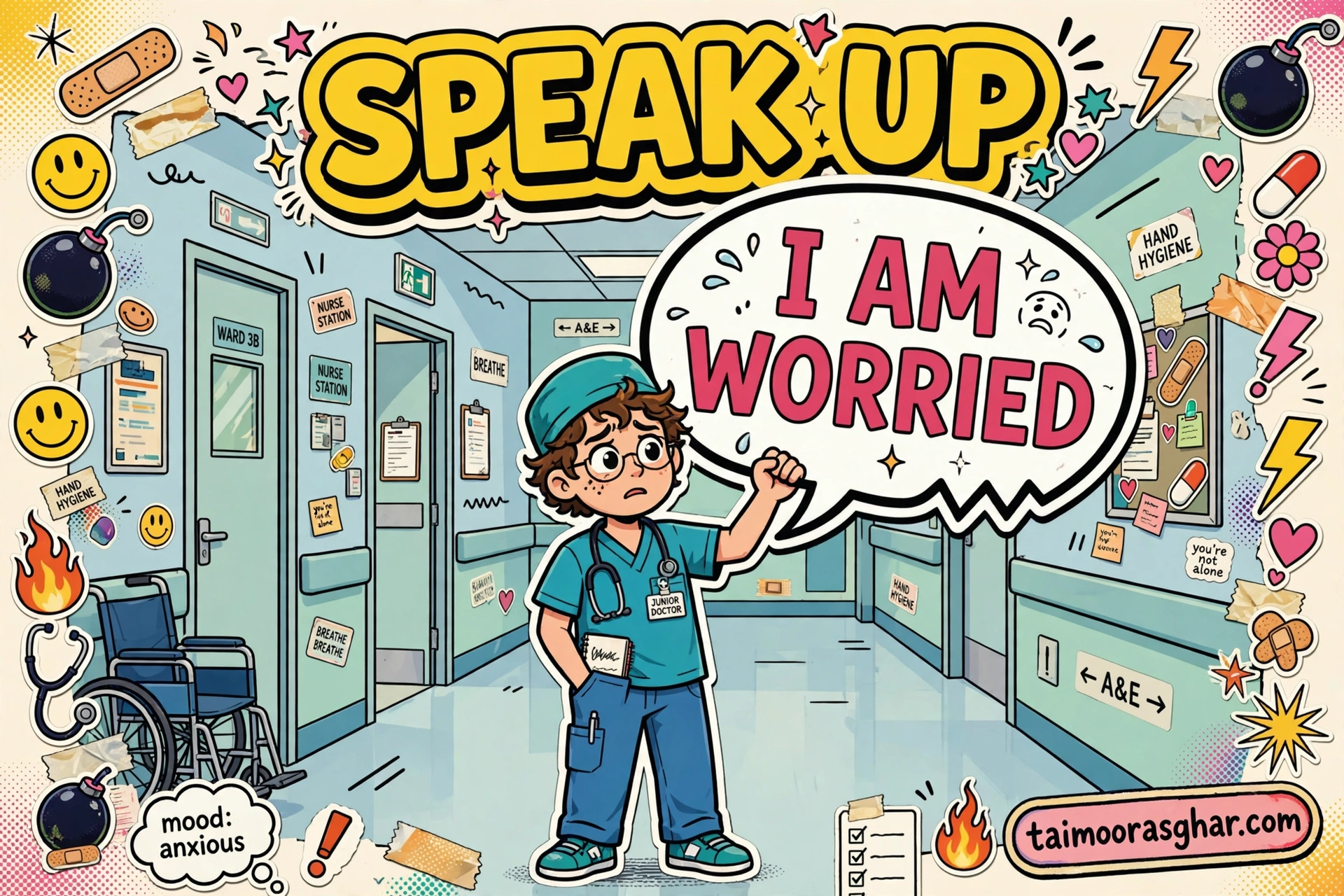
How to speak up about patient safety is not something medical school teaches you properly. Every junior doctor imagines they will do it instinctively, until they are standing on a ward where they are the newest face, the hierarchy is unreadable, and a small voice wonders whether saying "I am worried" will sound like diligence or insubordination. I know that voice. I heard it for a full year after I moved countries to practise medicine in a language that was not my own.
I was clinically competent. I had trained hard and I knew my medicine. But competence and voice are different things. Speaking up is not a personality trait. It is a skill, and like every skill in medicine, it has to be learned deliberately. Moving countries taught me that in a way no induction week ever could.
Why was speaking up so hard in my first year abroad?
When I started working as a doctor in Denmark, the hierarchy looked flat on paper. People used first names. Consultants ate in the same canteen. But flat on paper does not mean legible to an outsider. I did not know which questions were welcome and which would mark me as difficult. I did not know whether asking for feedback would be read as admirable self awareness or as an admission that I was struggling. So I did what many international graduates do. I stayed quiet, worked harder, and hoped competence would be visible without me having to claim it.
The problem with that strategy is that quiet competence is invisible in a system that runs on communication. Patient safety is a team sport. The doctor who notices something and says nothing is no safer than the doctor who notices nothing at all. I learned that slowly, and I learned it the hard way, one awkward conversation at a time.
There were three things I found hardest. The first was asking for feedback. In my training culture, feedback flowed one way, from senior to junior, and you received it rather than requested it. In Denmark, nobody was going to hand it to me unprompted, and requesting it felt like confessing a weakness. The second was escalation. Raising a concern about a process felt uncomfortably close to accusing a colleague, and I was terrified of being the foreign doctor who complains. The third was admitting mistakes, because every mistake I made happened in my second language, and owning one felt like proof that I did not belong.
What does the evidence say about speaking up in medicine?
This is not only an immigrant problem. It is a system problem, and the numbers say so. In its 2025/26 annual report, the National Guardian's Office, which oversees Freedom to Speak Up in the NHS in England, reported that patient safety or quality issues featured in 17.0% of the cases raised with guardians, a total of 3,083 cases. The most reported theme was inappropriate attitudes and behaviours at 41.6% of cases (7,535), followed by worker safety or wellbeing at 39.2% (7,097) and bullying and harassment at 17.7% (3,202). Notably, the National Guardian's Office itself closed on 30 June 2026, with Freedom to Speak Up responsibilities transitioning to NHS England and some functions devolving to trusts and local organisations, and a further move to the Department of Health and Social Care planned once legislation passes.
The trend is not reassuring. The Freedom to Speak Up subscore in the NHS Staff Survey fell from 6.5 in 2021 to 6.4 in the most recent published analysis, a 1.5% change that equates to more than 9,000 workers losing confidence in speaking up. The analysis also found that trusts with higher Freedom to Speak Up subscores were more likely to be rated good or outstanding by the Care Quality Commission. Speaking up culture and care quality move together, which is exactly what you would expect if safety depends on people opening their mouths.
There is infrastructure. More than 1,300 Freedom to Speak Up Guardians now support NHS staff in England, and the national policy sets minimum standards for how concerns are handled. But infrastructure only works if people use it, and people only use it if they feel safe.
Why do international graduates find it harder to raise concerns?
For international medical graduates, the general difficulty has an extra layer. A 2026 analysis in the BMJ noted that of the 422,048 doctors registered with the General Medical Council, 192,278 were trained overseas. Many join the NHS with substantial professional experience and a strong commitment to patient care, yet encounter what the piece called avoidable barriers early in their UK careers: differential treatment in GMC processes, inadequate induction, limited early supportive feedback and professional isolation. GMC chief executive Charlie Massey has said that "deep rooted inequalities in medicine continue to impact careers and opportunities for ethnic minority and non-UK qualified doctors working in the NHS."
The GMC has also acknowledged that international graduates account for a disproportionately high share of fitness to practise concerns raised by employers, while insisting that "the quality of registrants isn't the issue, it's deficits in the system." Research the GMC commissioned, published as Fair to refer?, found that a lack of timely, direct and honest feedback, given in a way that is sensitive to difference, limits a doctor's opportunity to demonstrate learning from mistakes and improvements to their practice.
Read those findings together and you see the trap. Newcomers get less feedback. With less feedback they have fewer chances to show they are learning. That makes them more likely to be referred into formal processes, which makes them more afraid to speak up, which means they get even less feedback. The way out of the loop is to pull feedback toward yourself instead of waiting for it to arrive.
How can you ask for feedback when nobody offers it?
This is the most practical lesson I learned. Feedback is not only given; it can be pulled. Nobody taught me this. I had to build the habit myself, and these are the specific moves that worked.
First, ask for one specific thing instead of general reassurance. "Was my handover clear enough on the sickest patient?" gets you a usable answer. "How am I doing?" gets you a polite one.
Second, book a five minute end of week check with your supervisor and put it in the diary. Five minutes is short enough that a busy consultant will say yes, and regular enough that feedback becomes routine rather than a verdict.
Third, write a short self summary before any appraisal or review meeting. Two lines on what went well and two on what you want to improve. It lowers the cost for a busy supervisor to respond honestly, because you have already opened the door.
Fourth, separate the feedback from your identity. "What should I change next time?" is a question about the work. "Am I good enough?" is a question about you. Only the first one is answerable, and juniors who ask the first one get better answers.
Fifth, if you are working in a second language, write the question down before you ask it. Written words are more precise than spoken ones when you are under pressure, and a supervisor who sees a clear written question will give you a clearer answer.
There is also formal help. The GMC runs Welcome to UK practice workshops that give new doctors the chance to ask the GMC team directly about what is expected of them, and some trusts build a full induction week around professional skills, systems and communication. If your trust offers one, go, and go with questions prepared. If it does not, the habit of pulling feedback still works without it. For more on choosing where to build your career as an international graduate, I have written about which country is best for IMGs in 2026 and what it actually takes to practise in Denmark.
How do you raise a patient safety concern safely?
Escalation is the part everyone fears, so it helps to see it as a ladder. You climb one rung at a time, and most concerns never need the top ones.
Start with the person directly involved, with facts and curiosity rather than accusation. "I noticed the prescription says X but the chart says Y, can you help me understand?" is disarming in any language. It gives the other person a way to be your ally instead of your adversary.
If that does not resolve it, tell your supervisor or the nurse in charge. Frame it as a question about the system, not a verdict on a person. "I am worried this process could let an error through" lands very differently from "someone made an error."
Use the formal incident reporting route for anything that reached, or could have reached, a patient. Contemporaneous notes protect you. Write what happened, when, and what you did, while it is fresh.
If you cannot raise it through the usual channels, contact your Freedom to Speak Up Guardian. In England there are more than 1,300 of them across NHS organisations, and they report concerns to the national office in anonymised form. Their whole job is to be the route for people who feel unable to use the other routes.
And if internal routes fail, know that the National Guardian's Office and NHS England are prescribed persons who can receive protected disclosures, including concerns about safety and quality, under the Public Interest Disclosure Act 1998. The whistleblowing charity Protect, formerly Public Concern at Work, offers independent advice. You do not have to navigate this alone, and you should not.
What did admitting a mistake in a second language teach me?
The moment that changed me was small. Early in my time in Denmark, I misheard a verbal instruction about a medication dose. I caught it before it reached the patient, and then I had a choice: say nothing and fix it silently, or tell the nurse what had happened. My instinct screamed for silence. Owning a mistake in broken Danish felt like handing people evidence that I was not up to the job.
I told her. And what happened next is the reason I am writing this. She did not punish me or pity me. She thanked me, and then she changed the process: from that day on our ward, verbal dose changes had to be read back and confirmed in writing. My mistake, admitted out loud, made the ward safer for every patient after me. That is when I understood the honesty dividend. Admitting a mistake is not a confession of incompetence. It is the fastest way to learn the language of safety, in whatever language you are speaking.
Five questions to ask before you stay silent
I keep a short list for the moments when the small voice tells me to stay quiet. It has never steered me wrong.
- What is the worst realistic outcome if I say nothing? If the answer involves a patient, speak.
- Am I worried about the patient, or about how I will look? Honesty about your own motive clears the fog.
- Who is the lowest risk person I can ask? You do not have to start with the consultant.
- Can I phrase it as a question? Questions invite; accusations provoke.
- What would I want a colleague to do if the patient were my own family? That one ends the debate every time.
Frequently asked questions
How do junior doctors speak up about patient safety in a new country?
Start with curiosity and facts: describe what you noticed and ask for help understanding it. Use your supervisor, the nurse in charge or the formal incident reporting route, and know that Freedom to Speak Up Guardians exist precisely for staff who feel unable to use the usual channels. Phrasing concerns as questions about the system rather than verdicts on people keeps the conversation safe.
What is Freedom to Speak Up in the NHS?
Freedom to Speak Up is the NHS approach to creating a culture where every worker feels able to raise anything that gets in the way of delivering great care, including patient safety concerns, poor behaviours and ideas for improvement. Every NHS organisation in England is expected to follow the national Freedom to Speak Up policy, and more than 1,300 guardians support staff in raising concerns. Speaking up data is published by the National Guardian's Office.
Who can international medical graduates talk to about a patient safety concern?
The same routes as everyone else: your supervisor, the nurse in charge, the patient safety or clinical governance team, and your organisation's Freedom to Speak Up Guardian. If internal routes do not work, the National Guardian's Office and NHS England are prescribed persons who can receive protected disclosures, and the charity Protect offers independent advice.
Why do international medical graduates find it harder to raise concerns?
Research points to a combination of inadequate induction, limited early supportive feedback, professional isolation and unfamiliar hierarchies. A 2026 BMJ analysis described these as avoidable barriers, and GMC commissioned research found that a lack of timely, direct and honest feedback limits doctors' chances to demonstrate learning. The difficulty is structural, not personal, which means it can be addressed with deliberate habits.
Does asking for feedback make a junior doctor look weak?
No. Asking for specific feedback is read by most supervisors as a sign of professionalism, not weakness. The trick is to ask narrow, answerable questions, such as whether your handover was clear, rather than broad ones like "how am I doing." Regular short feedback conversations normalise the habit and make it routine rather than dramatic.
What should a doctor do after making a clinical mistake?
Make sure the patient is safe first, then tell the relevant colleague or supervisor promptly and honestly, document what happened contemporaneously, and use the formal incident reporting route. Honest disclosure is how individuals and systems learn. Research on speaking up culture shows that organisations where staff feel safe to raise concerns also tend to deliver better care.
The quiet skill that changes everything
Moving countries did not make me a braver doctor. It made me a more deliberate one. I learned that speaking up is a clinical skill like any other: it has a technique, it improves with practice, and it fails when you leave it to instinct. The ward is safer when the newest person in the room can ask the simplest question. If you are that person right now, in a country that is not yet home, know that the voice telling you to stay quiet is not wisdom. It is just unfamiliarity. The skill is learnable, the routes exist, and the patients are worth it. For practical guidance on building the networks that make all of this easier, see my piece on finding mentorship as an international medical graduate.