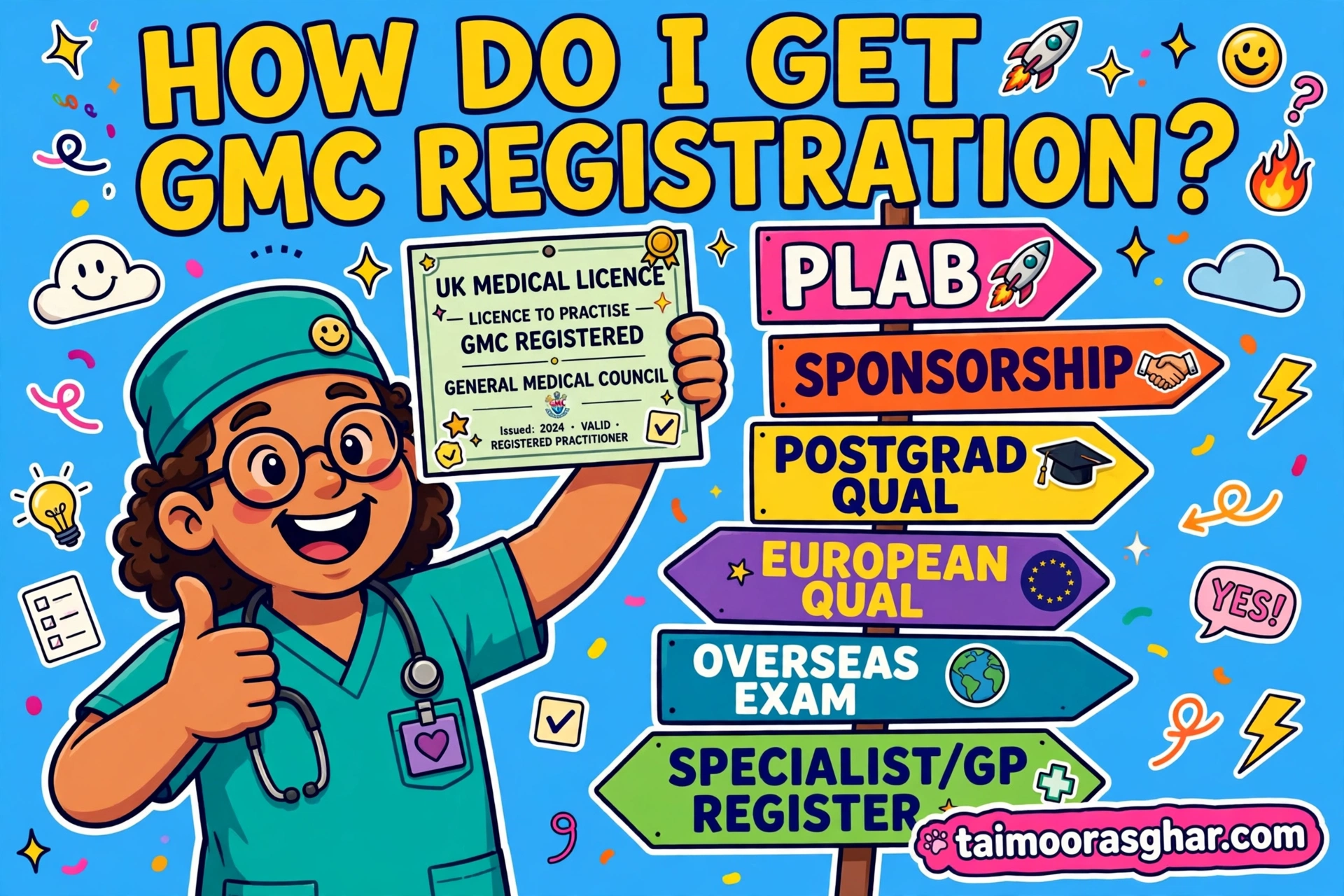
The short answer: as an international medical graduate, you get GMC registration by proving three things: an acceptable primary medical qualification, evidence of your knowledge of English, and enough clinical experience through one of six approved routes. For most IMGs that route is the PLAB test, and the whole journey, from EPIC verification to the registration decision, runs through the GMC’s online application.
It is a journey more doctors are making than ever, even as the flow slows. The GMC’s workforce report 2025 found that more than two thirds of new registrants qualified outside the UK, with 20,060 non-UK qualified doctors joining in 2024, only slightly more than the 19,629 who joined in 2023. Non-UK qualified doctors now make up around 42 per cent of the UK medical workforce. But the same report showed 4,880 internationally qualified doctors leaving UK practice in 2024, a 26 per cent rise on the year before, and the GMC’s chief executive warned in June 2026 that the NHS can no longer assume overseas medics will stay. Registration is the gateway, and it is worth understanding exactly how it works before you start.
What is GMC registration, and is it the same as a licence to practise?
The GMC keeps the medical register: your name on it is your registration. A licence to practise is the separate legal permission to practise medicine in the UK. You apply for both together, and for most purposes they travel as a pair.
The GMC puts it plainly: doctors need full registration with a licence to practise to either move on to the second year of the Foundation Programme (F2) in an approved training programme, or to work in unsupervised medical practice in the NHS or UK private practice. There are other types of registration, including provisional registration for doctors entering the UK Foundation Programme and specialist or GP registration for consultants and GPs, but this guide is about the one most IMGs need: full registration with a licence to practise.
What are the six routes to full registration?
The GMC’s eligibility guidance says that graduates with an acceptable primary medical qualification from outside the UK must prove they have enough clinical experience to practise medicine in the UK, and it lists six ways to do that:
- A pass in the PLAB test. The Professional and Linguistic Assessments Board test, in two parts, is the standard licensing exam route for IMGs.
- Sponsorship by a GMC approved sponsor. An approved sponsor supports your registration for a specific post, typically a fixed-term training or fellowship post. The Royal College of Physicians’ sponsorship scheme, for example, requires a recognised primary medical qualification verified by ECFMG, a postgraduate qualification, three years of post-qualification experience and a formal NHS job offer.
- An acceptable postgraduate qualification. Certain postgraduate qualifications let you demonstrate your knowledge without sitting the PLAB test.
- Relevant European Qualification. For doctors holding qualifications covered by the recognition arrangements for the EEA and Switzerland.
- An Acceptable Overseas Registration Examination. The GMC publishes a short list of overseas licensing examinations it accepts as equivalent evidence of knowledge and skill.
- Eligibility for entry onto the Specialist or GP register. For experienced doctors whose training qualifies them for specialist or GP registration, which carries full registration with it.
Read that list carefully and one route stands out as the one most IMGs actually use. The next section explains why.
Is PLAB really the only realistic route?
In practice, for most IMGs, yes. According to analysis of the GMC’s workforce report 2025 published in October 2026, doctors joining the register via the PLAB route grew by 27 per cent in 2024, while numbers fell across every other non-UK route to the register. Sponsorship needs a sponsor and a specific post. The postgraduate qualification route needs a qualification the GMC accepts. The European route needs the right qualification from the right place. For an IMG without any of those, PLAB is the door that is actually open.
One nuance worth knowing: the GMC’s chief executive noted in June 2026 that demand for the PLAB test had fallen more recently. That likely reflects the tougher employment picture for new joiners rather than the exam getting easier. If you are weighing up which exam to book and what the two parts actually involve, read the companion guide: PLAB or UKMLA in 2026? What IMGs actually need to book.
What evidence does the GMC actually ask for?
Whichever route you take, the application asks for a familiar bundle of evidence. Get these ready before you start the online application, not after:
- An acceptable primary medical qualification. Check the GMC’s acceptability criteria for your qualification before anything else. This is the single most expensive mistake IMGs make: building a plan around a degree the GMC will not accept. The GMC decides what counts, and there is no appeal against a refusal.
- Primary source verification. Non-UK qualifications must be independently verified, typically through ECFMG’s EPIC service, which contacts your awarding institution directly to confirm your credentials. Start this early: it is the step you control least, because it depends on your medical school responding.
- An acceptable internship. IMG application guides summarise the GMC’s expectation as at least 12 months of continuous hospital practice immediately before or after graduation, with at least three months each in medicine and surgery for internships of 12 to 18 months, evidenced by a completion letter on headed paper with your dates and rotations.
- Evidence of your knowledge of English. The most common evidence is IELTS Academic, with an overall score of at least 7.5 and at least 7.0 in each area, or OET Medicine, with at least grade B in each area. Tests are valid for two years, and the scores must come from a single sitting. The GMC lists other accepted routes, including recent qualifications taught and examined entirely in English.
- Certificates of good standing from every medical regulator you have been registered with in the last five years, plus employer references covering your recent practice.
- An identity check, which the GMC runs through a digital process or in person, confirming that the applicant matches the documents.
That is the full bundle. Nothing on it is exotic, but every item must be current and every document must agree with the others: names, dates and spellings that differ across certificates are one of the most common causes of delay.
How much does GMC registration cost in 2026?
The GMC publishes a schedule of fees, and the figures below are the ones effective from 1 April 2026:
| Fee | Amount |
|---|---|
| Application for full registration with a licence to practise | £481 |
| Discounted application (fixed-term discount) | £184 |
| PLAB 1 | £283 |
| PLAB 2 | £1,036 |
| Annual retention fee, with a licence to practise | £481 |
| Scrutiny fee if the application is refused, closed or withdrawn | £110 |
The fixed-term discounted application fee of £184 applies if you passed your primary medical qualification within the past five years, or if you are moving from provisional to full registration. There is also a 50 per cent discount for doctors whose worldwide income is under £38,500. For a standard applicant taking the PLAB route, the core GMC and exam total is £283 plus £1,036 plus £481, which comes to £1,800. Treat that as the floor, not the budget: English tests, EPIC verification, visas, travel and accommodation for PLAB 2, and living costs while you wait for a post all sit on top, and most candidates spend several thousand pounds all in.
Where do IMGs most often get tripped up?
Assuming the qualification is acceptable. Say it again because it matters: check the GMC’s acceptability criteria for your primary medical qualification before you book anything. There is no appeal against a refusal, and discovering this late is the costliest possible outcome.
Letting the English test expire. Two-year validity catches people who sat IELTS or OET early in a long preparation and then took their time over the exams. Make sure the test is still valid when you apply, not just when you started.
Confusing registration with employment. This is the misunderstanding the GMC’s own data exposes. Of the doctors who passed the GMC’s exam for international joiners and took up registration in 2024, only around one in eight had connected to a designated body, a sign they were working as a doctor, within six months. That was down from one in five in 2023 and one in four in 2021 and 2022. Registration is the licence; the job hunt is a separate campaign, and it is getting harder. The BMA has reported that among applicants for specialty training, 23 per cent of overseas-qualified applicants secured posts compared with 69 per cent of UK graduates.
Applying before the evidence is ready. Start the online application when the bundle is complete, not when you feel ready. EPIC verification, good-standing certificates and references all take calendar time you cannot hurry.
What happens after registration is granted?
Once granted, you hold full registration with a licence to practise, and you pay the annual retention fee each year on the anniversary of your registration (£481 with a licence to practise, from April 2026). You connect to a designated body, usually your employer, for appraisal and revalidation, which comes around every five years.
Then the real work starts: finding a post, settling into a new system, and building the career the registration was for. Two companions to this guide: how to find guidance when the system hands you none, and how to turn your first non-training post into portfolio evidence.
Why this matters beyond the paperwork
The UK’s medical workforce is structurally dependent on international doctors: around 42 per cent qualified outside the UK, and in recent years two thirds of new joiners trained overseas. But growth in internationally trained joiners has slowed sharply, from over 60 per cent to over 20 per cent and now to around 2 per cent, while the number leaving has risen. Against that backdrop, the government’s plan to prioritise UK graduates for postgraduate training places in England has sharpened the debate about who gets a foothold. For background on that policy, see what the UK’s Medical Training Prioritisation Act really means for IMGs.
None of that changes the mechanics of registration, but it changes the strategy. Choose the route that fits the qualifications you actually hold, verify your primary medical qualification first, budget the real cost before you book a single exam, and treat the job search as a second campaign that starts the day registration is granted. The doctors who struggle are rarely the ones who failed an exam; they are the ones who assumed the paperwork would take care of itself.
Frequently asked questions
Can I get GMC registration without PLAB?
Yes. The GMC lists six ways to prove enough clinical experience: a PLAB pass, sponsorship by a GMC approved sponsor, an acceptable postgraduate qualification, a relevant European qualification, an acceptable overseas registration examination, or eligibility for the specialist or GP register. In practice, though, most IMGs use the PLAB route because the other doors need a specific post, a specific qualification or a specific background.
How long does GMC registration take?
Published application guides suggest allowing four to eight weeks from a complete application to a decision. The biggest variable is primary source verification, which depends on your medical school responding to ECFMG, so start EPIC early and treat any timeline as a guide rather than a promise.
Does GMC registration let me work in the UK?
It gives you the legal right to practise medicine, but not the right to work: you still need immigration permission and a job offer. Registration and employment are separate processes, and the GMC’s own figures show that a shrinking share of newly registered international doctors are in work within six months.
What if my medical school is not acceptable to the GMC?
Then that qualification cannot be used for registration, and the GMC offers no appeal against its acceptability decision. Some doctors pursue an alternative route, such as an accepted postgraduate qualification, but the starting point is always the same: check acceptability before committing money or time.
How long is my IELTS or OET valid for GMC registration?
Two years, and the scores must come from a single sitting. Make sure the test is still valid on the date you apply, not just the date you started preparing.
Do I pay the registration fee every year?
You pay an application fee to join the register (£481 standard, or £184 with the fixed-term discount, from April 2026) and then an annual retention fee for every year you stay on it (£481 with a licence to practise, from April 2026). A 50 per cent discount is available if your worldwide income is under £38,500.
Sources
- GMC: What is full registration and who is eligible?
- GMC: Registration fees for doctors explained (schedule effective 1 April 2026)
- GMC: Which qualifications need to be verified?
- GMC: UK health services risk ‘huge holes’ if internationally qualified doctors quit (workforce report 2025)
- GMC: NHS can no longer assume much-needed international medics will stay (11 June 2026)
- Royal College of Physicians: GMC sponsorship scheme eligibility requirements
- BMA: IMGs increasingly relinquishing medical licences, finds GMC
- ProMedical: International doctor inflow plateaus in 2024 after years of rapid growth, GMC report finds (14 Oct 2026)