How Long Does It Take to Publish a Research Paper? Realistic Timelines for Clinicians
If you have just finished your first manuscript, the next question arrives almost immediately: how long does it take to publish a research paper? The honest answer is that it usually takes longer than authors expect. Across 104 journals, the median time from submission to acceptance is 153 days, about five months, and that is before the production stage adds its own weeks. Yet that single median hides a dramatic range, from around 30 days at the fastest journals to more than 400 days at the slowest.
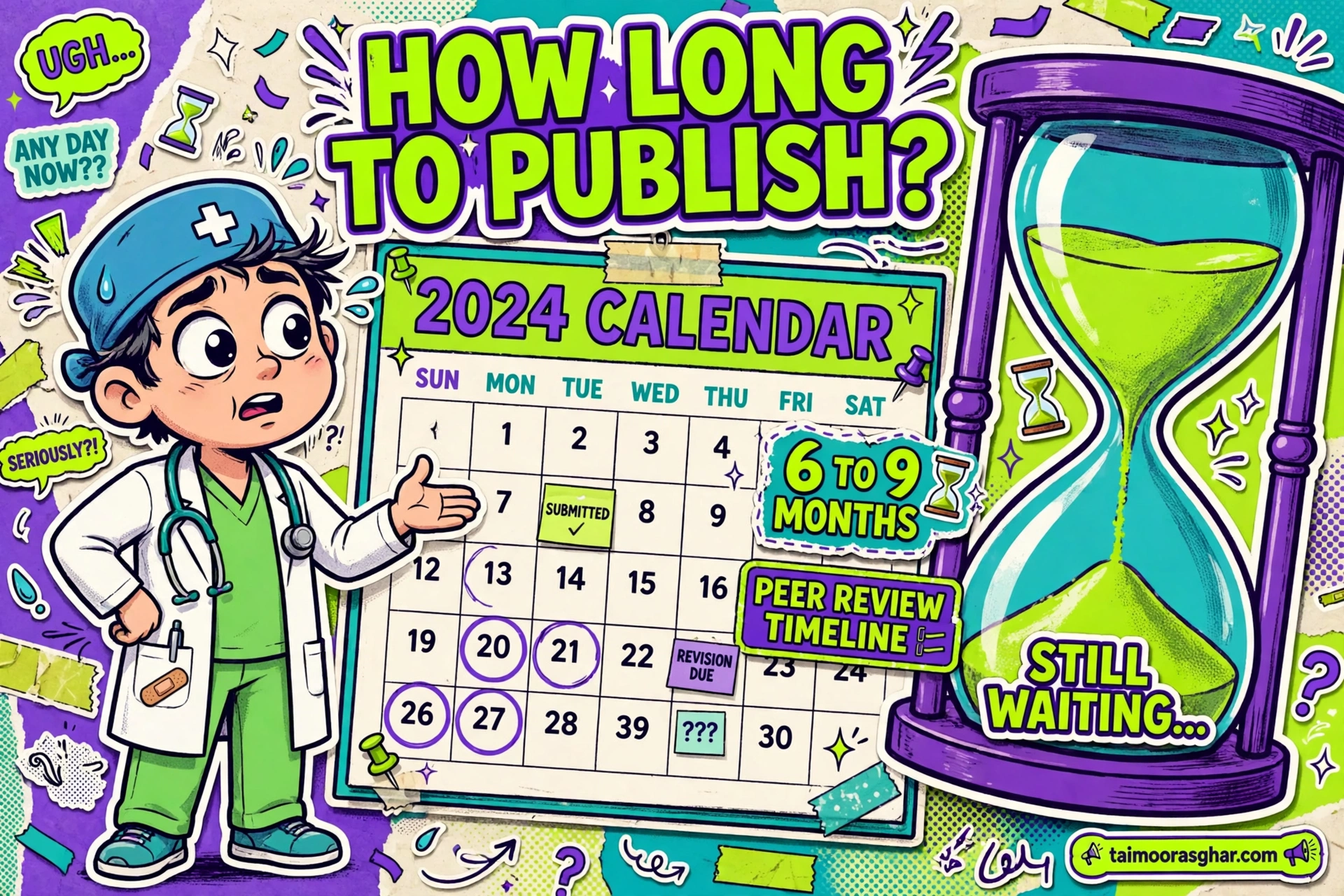
For a clinician or junior researcher submitting a first paper, the realistic expectation is this: most papers take six to nine months from submission to appearing online, and a full year is not unusual once rejections, revisions and production are counted. This guide breaks the timeline into its real stages, shows what the published data says, and explains what you can do to avoid losing months you never needed to lose.
The five stages of publication, and what each one really takes
Every manuscript goes through the same sequence, though not every manuscript survives all of it. Knowing the stages matters because each one has its own clock, and its own ways of stretching.
Stage 1: Editorial screening, days to a few weeks
After submission, a staff editor or associate editor reads the paper for scope, quality and basic standards. This desk stage is fast at many journals: PLOS Medicine reports that 91% of research submissions receive an initial decision within 5 days, and JAMA Network Open reports a median of 2 days for papers decided without external review. At other journals it can run to two or three weeks, especially when editors consult colleagues about whether to send the paper out. If the verdict is a desk rejection, you get the paper back quickly, but you then restart the entire clock at a new journal.
Stage 2: Peer review, four weeks to four months
Papers that pass screening go to two or three external reviewers. This is the most unpredictable stage. An analysis of 57 health policy journals published in 2024 reported a median of 60.5 days to the first peer-reviewed decision. PLOS ONE, which runs a high-throughput workflow with reviewers typically given 10 days, reported a median of 45 days to first decision in the first half of 2023. The delay usually comes not from reviewers reading the paper, but from finding reviewers willing to read it, and from chasing late reports.
Stage 3: Your revision, as fast or as slow as you make it
Most manuscripts come back with requests for revision rather than acceptance. This stage is the one authors control most completely. Revision windows at many journals run two to three months, but the deadline is an upper bound, not a target. Returning a careful, complete revision in three to six weeks keeps the momentum the editors associate with a strong submission. A revision that needs new data or extra analysis will take longer, and that is usually time well spent, since it is the revision that converts a borderline verdict into an acceptance.
Stage 4: Re-review and the final decision
The revised manuscript goes back to the editor, and often to the original reviewers. PLOS ONE’s medians show how this accumulates: 45 days to first decision, 87 days to final decision, 188 days to acceptance. At Nature Methods, the publisher-reported figures are a median of 10 days to first decision but 239 days to acceptance, a gap of nearly eight months spent almost entirely in review and revision rounds. Each round trip adds weeks, which is why a clean first submission is worth so much.
Stage 5: Production, from acceptance to online, two to eight weeks
After acceptance comes copyediting, proofreading, typesetting and formatting. Journals with continuous online publication can post the accepted version within days, while issue-based journals may queue the paper for months. Many journals now post a citable version online ahead of the formatted issue, so the work is discoverable well before it appears in an issue. This stage is largely out of your hands, though returning proofs promptly shaves real time off it.
What the published numbers say about realistic timelines
Aggregate data makes the range concrete. A 2025 analysis of receipt-to-acceptance medians across 104 journals, based on 27,286 dated records, puts the median of those medians at 153 days. The fastest journals in that panel, Nutrients (30 days), Polymers (32.5 days) and Materials (35 days), accept in about a month. The slowest, Nature Human Behaviour (329 days), Nature Genetics (371 days) and Nature Neuroscience (423.5 days), take well over a year on average, with author revisions included in those figures.
For clinical authors, the relevant comparators sit in the middle of that range. BMJ Open reports a median of 134 days to first decision with review. JAMA Network Open reports 46 days with review and 2 days without. PLOS Medicine reports 67 days to first decision for 2025. The 2024 health policy journal analysis put the median time to final decision at 198 days. None of these figures include production, so add several more weeks before the paper is visible online.
Two patterns in the data deserve attention. First, the gap between first decision and acceptance is large almost everywhere, which means revisions and re-review, not the initial review, are where most of the calendar goes. Second, journal prestige correlates with delay: the selective journals are slower not because their reviewers read more slowly, but because of higher desk rejection rates, multiple review rounds, and the editorial deliberation that high rejection rates require.
Why good papers still take longer than the optimistic estimates
Three things systematically stretch timelines beyond the figures journals advertise. The first is the desk rejection cycle. Selective journals reject most submissions without review, the Lancet being the well-known extreme where about nine in ten never reach a reviewer. Each desk rejection costs the quick desk clock but then demands a full resubmission elsewhere, so two fast desk rejections can quietly consume two months.
The second is scope mismatch. Papers sent to journals whose scope only partly fits tend to bounce: editors desk-reject them quickly, or reviewers return reports that criticise the framing rather than the science. The first article in this series on how to publish your first paper covers choosing the right journal; it is the single highest-leverage decision in the whole timeline.
The third is reviewer scarcity. Every journal draws on the same pool of busy scientists, and reviewers increasingly decline or go quiet. Journals rarely admit this on their timelines pages, but the gap between reviewer invitation and reviewer report is the main source of variance in stage two. It is also largely outside your control, which is why one of the few levers you do have is suggesting qualified reviewers with your submission, something most journals explicitly invite.
What you can actually control to shorten the timeline
Some of the calendar is fate, but a surprising share is authorship. These are the levers that move the needle:
Fit the journal first, write the cover letter second. Editors triage in minutes. A cover letter that states the research question, the key finding and why it suits this journal’s readers helps an editor see fit instantly, and suggests a reviewer pool in the same breath.
Submit a technically clean manuscript. Analyses of publication delays repeatedly find that formal non-compliance, formatting errors, statistical inconsistencies and incomplete data statements are among the leading causes of extra review rounds. Checklists such as CONSORT or STROBE, and the journal’s own submission guide, exist to remove these friction points before they cost you a round trip.
Suggest reviewers and oppose none without reason. Two or three genuine experts, unconnected to you, speed up reviewer assignment. Avoiding them suggests something to hide; journals notice.
Revise fast and completely. Address every reviewer point, quote or summarise the change in the response letter, and make changed text easy to find. The most common cause of a second major revision is an incomplete first one. Returning the revision within a month signals that the work is a priority, and editors treat it accordingly.
Use preprints to take calendar pressure off the decision. Posting on a preprint server does not replace journal publication, but it puts the work on the record and in front of readers while review runs. Several funders and institutions now recognise preprints in assessments, and a preprint means a slow review round never renders your findings stale.
A realistic timeline for a clinician submitting a first paper
Put it together for a typical first submission from a working clinician. Weeks 1 to 3: desk screening and reviewer assignment. Months 1 to 3: peer review and the first decision. Months 3 to 5: your revision, assuming no new data collection. Months 5 to 7: re-review and acceptance. Weeks 1 to 6 after acceptance: production and online posting. That is six to nine months in the smooth case, and it assumes acceptance at the first journal, which is uncommon for first papers. Add one desk rejection and one full resubmission, and twelve months becomes the realistic number to plan around.
That should not discourage you. It should change how you plan: submit earlier than your deadlines require, keep a second-choice journal list ready before you submit to the first, and treat the revision window as sacred time. The authors who publish fastest are rarely the ones at the fastest journals; they are the ones who never let a manuscript sit untouched.
Frequently asked questions
How long does it take to publish a research paper on average?
The best aggregate figure is a median of 153 days from submission to acceptance across 104 journals, with production adding further weeks. For a realistic plan, assume six to nine months from submission to the paper appearing online, and up to a year once a desk rejection or second review round is factored in.
What is the fastest a paper can realistically be published?
Some journals accept in about 30 days, and papers posted to preprint servers are public within days of upload. But fast journal publication of a peer-reviewed original article in clinical medicine is rare. Anyone promising acceptance within days of submission is almost certainly not offering real peer review.
Why do desk rejections cost so much time?
The desk decision itself is fast, often within days. The cost is the reset: a new journal means new formatting, a new cover letter, new suggested reviewers and a new submission queue. Two quick desk rejections can consume two months of calendar time while adding nothing to the science.
How long should revisions take?
Journals typically allow two to three months, but the deadline is a ceiling. A minor revision can and should be returned in two to three weeks. A major revision requiring new analysis is worth the time it takes, since an incomplete revision is the most common route to a second review round. Aim for four to six weeks as a working default.
Can I post a preprint while the paper is under review?
Yes, at most journals in clinical medicine, and many explicitly allow it. A preprint establishes the date of your work, lets colleagues read and cite it, and removes the pressure of a slow review clock. Check the journal’s preprint policy before submitting, and update the preprint with the final version after publication.
How long does production take after acceptance?
Typically two to eight weeks from acceptance to the paper appearing online, depending on the journal. Journals with continuous online-first publication are fastest; issue-based journals may delay the formatted version. Returning author proofs quickly is the one part of this stage you control.
Related reading
- How Can I Publish My Own Research Paper? A Step-by-Step Guide for Clinicians
- Is It Free to Publish a Research Paper? APCs, Waivers and No-Fee Journals
- How Do I Get GMC Registration? The Six Routes for IMGs, Explained
Sources
- Manusights, Peer Review Timelines by Journal, receipt-to-acceptance medians across 104 journals (27,286 PubMed records, 2024 to 2025): https://manusights.com/review-timelines
- Enago, Speed vs. Prestige: How to Balance Journal Impact and Peer Review Timelines, 2024 analysis of 57 health policy journals: https://www.enago.com/articles/journal-review-timeline-vs-impact-factor/
- Manusights, Nature Methods journal metrics, median 10 days to first decision and 239 days to acceptance (2025): https://manusights.com/journals/nature-methods
- Manusights, PLOS Medicine journal metrics, 67 days median to first decision, 4% acceptance rate (2025): https://manusights.com:443/journals/plos-medicine
- Manusights, Cell review time, 10 days median to first editorial decision: https://manusights.com:443/blog/cell-review-time
- PLOS ONE reported review metrics, Jan to Jun 2023, 45 days to first decision, 87 days to final decision, 188 days to acceptance (via Enago): https://www.enago.com/articles/journal-review-timeline-vs-impact-factor/